Travel & stay

Goiânia, Brazil · 14–18 September 2026

Hotel, daily transport and workshop locations, plus the history of Goiânia and Cidade de Goiás and a map for your free time.

Your week

Where you stay, how you travel each day, and the two places the workshop takes you.

Your hotel

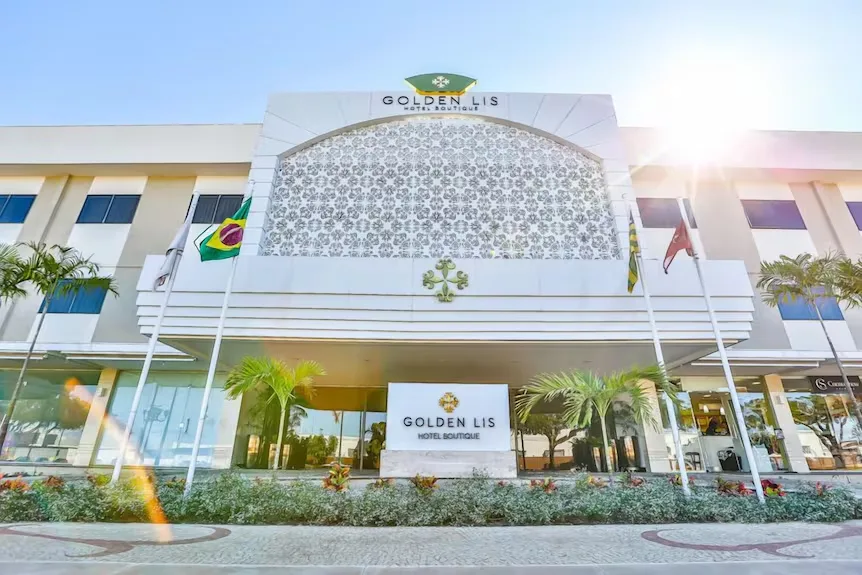
Golden Lis Hotel Boutique

Setor Santa Genoveva, Goiânia

Front entrance of Golden Lis Hotel Boutique in Goiânia
Photo supplied for this website

Arrival from the airport

Uber is recommended for travel from the airport to the hotel.

Av. das Indústrias, 75 — Setor Santa Genoveva, Goiânia — GO, 74670-600, Brazil

Stay
13–18 September 2026
Booking
Organised by the workshop
View location map
Golden Lis website

Daily transport

Workshop shuttle

Take the workshop shuttle from Golden Lis each day. Transport to the activities and back is organised.

Mon–Thu
08:00Departure from Golden Lis for the day’s workshop venue
Friday
06:00Departure from Golden Lis for Cidade de Goiás
View daily programme

Friday 18 September

Cidade de Goiás

Goiás state, north-west of Goiânia

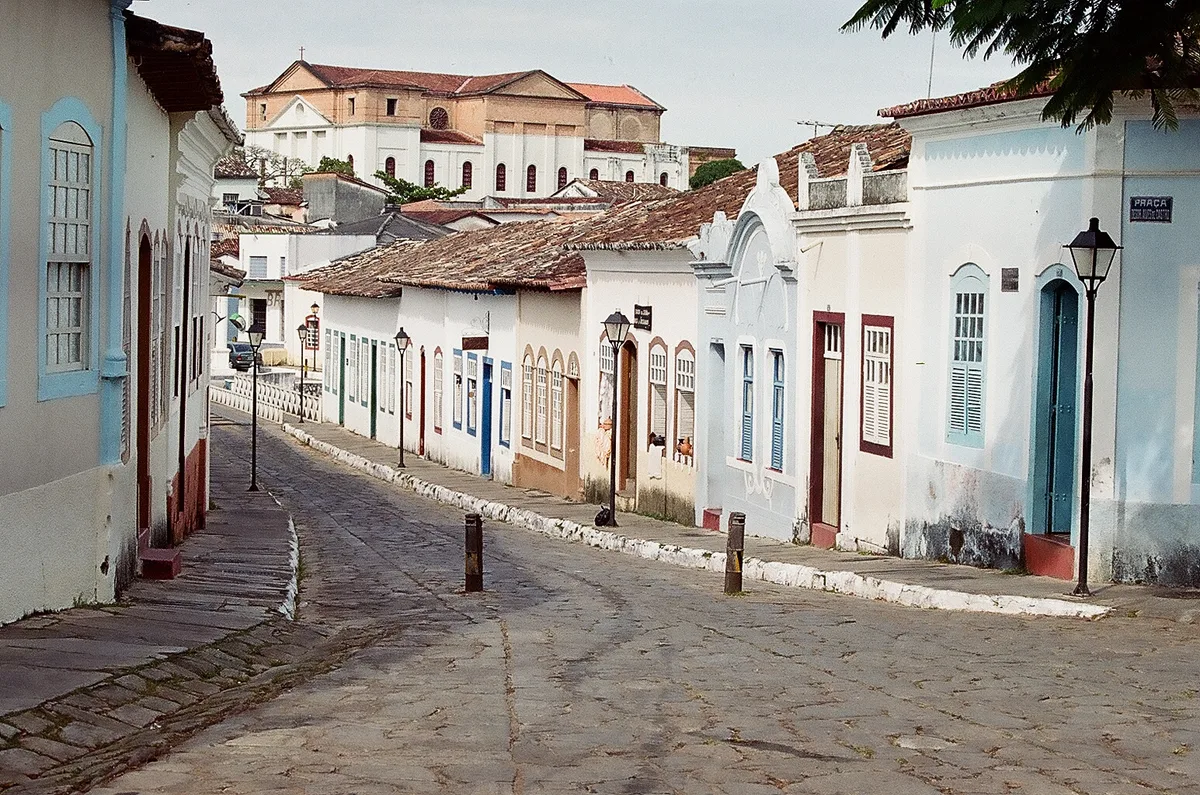
Historic street and colonial buildings in Cidade de Goiás
Historic centre · Adelano Lázaro · CC BY-SA 4.0
Workshop shuttle from Golden Lis · Friday 06:00

Cidade de Goiás grew from the gold-mining settlement of Sant’Anna, founded in 1727. Later known as Vila Boa, it became the region’s administrative centre and remained the capital until the government moved to Goiânia in 1937.

UNESCO World Heritage · 2001

View town map
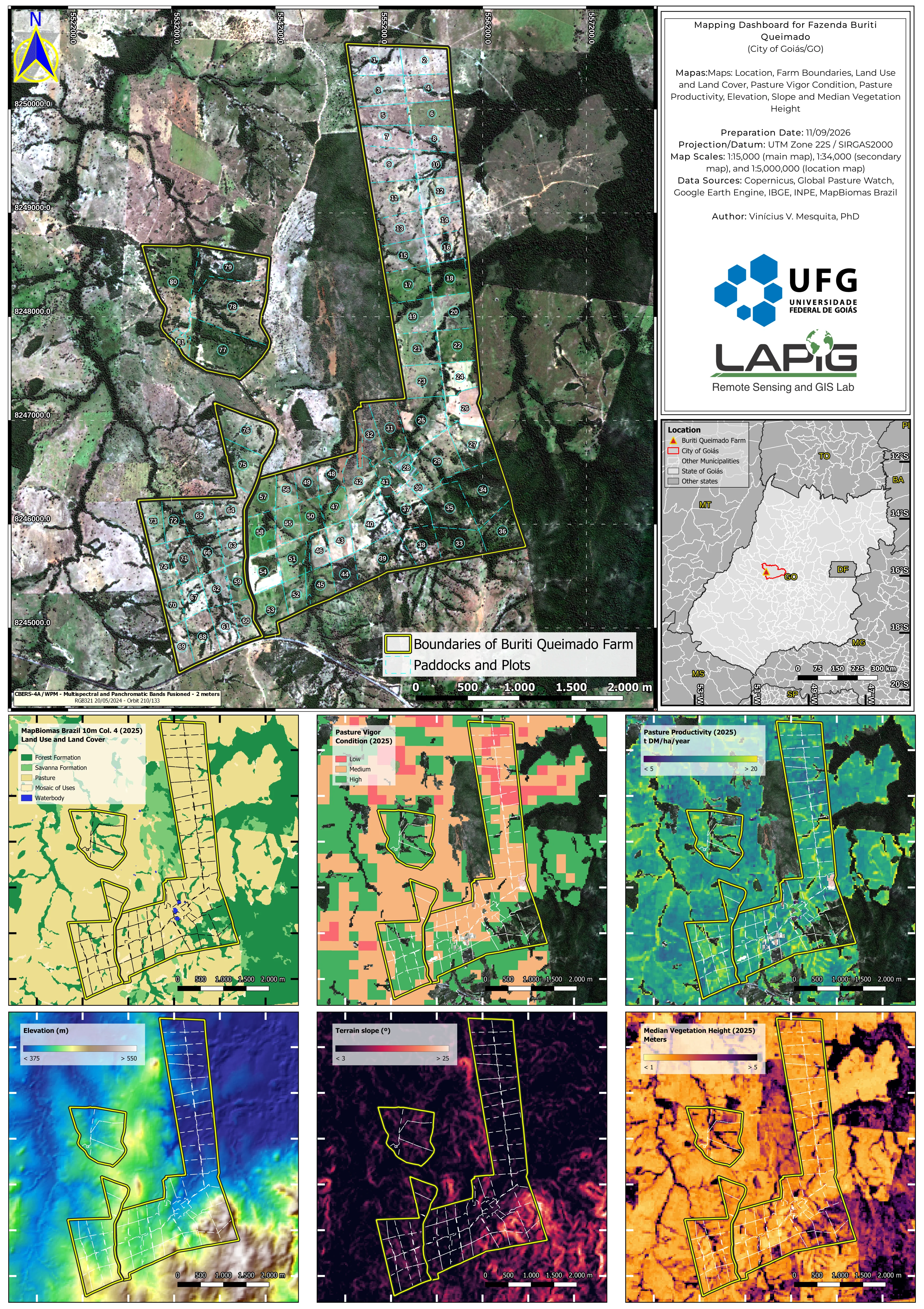
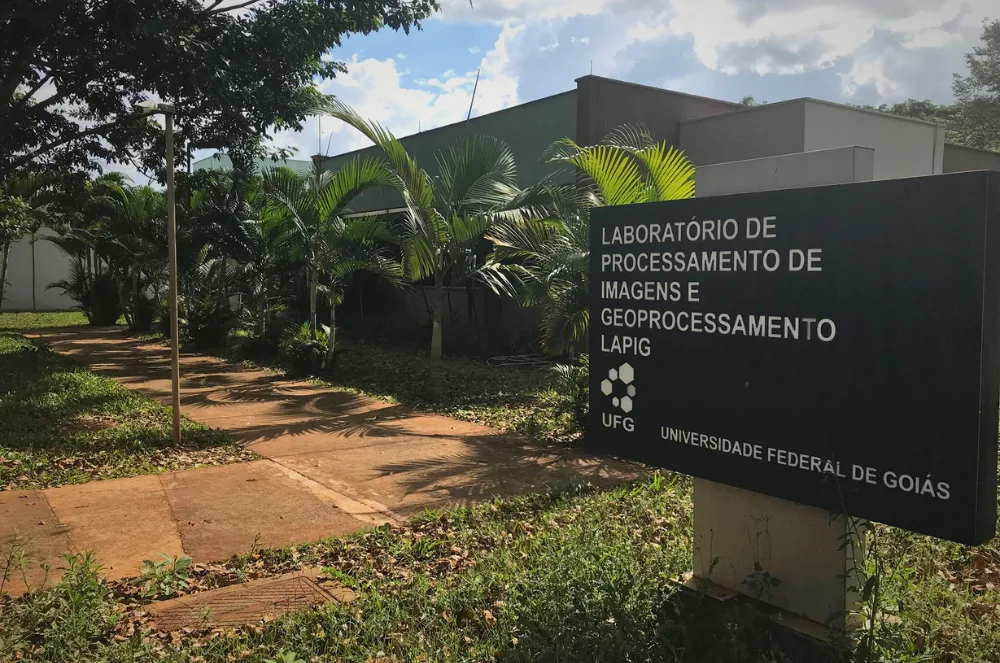
Map sheet of Fazenda Buriti Queimado. A satellite image of the farm with its boundary in yellow and numbered paddocks in cyan, a locator map of Goiás state, and six smaller maps of the same area: land use and land cover, pasture vigour, pasture productivity, elevation, terrain slope and median vegetation height.
Map sheet · LAPIG/UFG, 11 September 2026

Friday · 09:30 – 12:00

Fazenda Buriti Queimado

Field Visit: Grazing Livestock Farm · View session

Open full-size mapWebP · 3508 × 4967 px · 3.2 MB
On the sheet
  1. Farm boundaries, paddocks and plots over a CBERS-4A image, 2 m, 20 May 2024
  2. Land use and land cover · MapBiomas Brazil 10 m, Collection 4, 2025
  3. Pasture vigour condition · 2025
  4. Pasture productivity · 2025, t DM/ha/year
  5. Elevation · m
  6. Terrain slope · degrees
  7. Median vegetation height · 2025, m
Prepared by
Vinícius V. Mesquita, PhD · LAPIG/UFG
Date
11 September 2026
Projection
UTM zone 22S · SIRGAS 2000
Data
Copernicus, Global Pasture Watch, Google Earth Engine, IBGE, INPE, MapBiomas Brazil
History & cultureHistory and photos of Cidade de GoiásThe former capital, its river, and the poet who wrote from its bank.Learn more
History & culture

History & culture

Streets, landscape and literature

The former capital of Goiás carries its history in the relationship between the town, the river and the hills.

Settlement of Sant’Anna
1727
Capital moves to Goiânia
1937
World Heritage inscription
2001
A town shaped by its setting

Its historic centre follows the Rio Vermelho between surrounding hills. Streets, houses, churches and public buildings developed with the terrain, using local materials and building traditions. UNESCO recognised this urban and architectural heritage in 2001.

The river and the town

The Rio Vermelho runs through the historic centre. The relationship between water, hills and buildings is central to the town’s World Heritage recognition.

Cora Coralina

The poet Cora Coralina (1889–1985) is part of the city’s literary history. Her former home is now a museum preserving her manuscripts, photographs and everyday objects.

Living heritage

The city’s heritage also includes poetry, music, food and popular celebrations. These traditions remain part of local life alongside its preserved architecture.

Inside the poet’s world

The Museu Casa de Cora Coralina opened in 1989, on the centenary of the poet’s birth. Its collection includes manuscripts, photographs, correspondence, household objects and furniture.

Film & environmentFICA: cinema and the environmentAn environmental film festival the same town has hosted since 1999.Learn more
Film & environment

Film & environment

FICA Festival Internacional de Cinema e Vídeo Ambiental

An environmental film festival, held in Cidade de Goiás since 1999. Twenty-seven editions have now taken place in the same World Heritage town — the town this workshop visits on Friday.

The most recent edition ran in June 2026. The festival is not part of the workshop programme.

Cidade de Goiás, Goiás

A film festival whose entire subject is the environment.

First edition
1999
Editions through 2026
27
Competitive showcases
4
A festival with a subject

FICA is not a general film festival with an environmental strand — the environment is its whole subject, and it is in the festival’s name. It has been held in Cidade de Goiás since 1999, which makes it two years older than the town’s own World Heritage inscription. Recent editions have run in June.

The journalist who set its line

Washington Novaes (1934–2020) was an environmental journalist and filmmaker. He was FICA’s environmental consultant from the first edition in 1999 until 2008, and the state’s own account credits him with establishing how the festival approaches environmental questions — its themes, its guests and its debates. The main competition carries his name.

More than a screening programme

Around the competition the festival runs debates, roundtables and lectures, and filmmaking workshops in local schools. One of its screenings is powered by the audience: at BikeCine the projection runs on bicycles the public pedals. The three films above are television reports on exactly that — the festival as it works in the town, rather than as a list of titles.

Who runs it

The festival is organised by the Government of Goiás through its State Secretariat of Culture, with the Federal University of Goiás — the workshop’s host university — through Fundação RTVE. UFG has a campus in the town, and runs a student monitor programme for each edition.

A prize with an address

The best feature in the main competition receives the Prêmio Cora Coralina, named after the poet who lived and wrote in this town. Her house is now a museum, a few streets from the cinema where the prize is given.
What the festival competes over

Four competitive showcases
  • Mostra Internacional Washington Novaes

    International competition

    The main competition, open to environmental film from any country. It carries the name of the journalist who set the festival’s approach to environmental questions across its first ten editions.

  • Mostra Cinema Indígena e Povos Tradicionais

    Indigenous cinema and traditional peoples

    A competition of its own, rather than a category inside another one, for Indigenous cinema and the cinema of traditional peoples.

  • Mostra Cinema Goiano

    Cinema from the state of Goiás

    Film made in Goiás — the state the workshop meets in, and the one whose landscapes this week is about.

  • Mostra Becos da Minha Terra

    The alleys of my land

    Film made in Cidade de Goiás and the territory around it: the town that hosts the festival, and the town Friday goes to.

The 2026 selection

The most recent edition

Edition
27th edition
Dates
16–21 June 2026
Opened at
Cine Teatro São Joaquim
Theme
Água e Clima no Brasil das NascentesWater and climate in Brazil’s headwaters

The edition honoured the visual artist Dalton Paula, and opened with the national premiere of “A Curva do Rio”.

The festival in photographs

From the screen to the city

Speakers, audiences and filmmakers share the festival. These archive photographs show earlier editions; the films above cover 2026.

City & free time

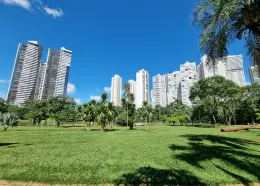
Goiânia is your base during the workshop week. Outside the programme, its parks, cafés and cultural venues offer places to spend your free time.

City historyHistory and photos of GoiâniaA capital drawn on paper in 1933, and what was listed in 2003.Learn more
City history

City history

Goiânia, a planned capital

A new capital, drawn in the twentieth century, grew beside the older settlement of Campinas.

  1. 1933

    A capital is founded

    Goiânia is founded, planned as the new capital of Goiás more than two centuries after the origins of Cidade de Goiás.

  2. 1937

    The government moves

    The state government transfers from Cidade de Goiás to the new city.

    The town it left
  3. 2003

    The Art Deco ensemble is listed

    IPHAN recognises the architectural and urban ensemble: 22 public buildings and monuments.

The shape of the city

Architect Attílio Corrêa Lima designed the new city around a civic centre. Its planned avenues and Art Deco buildings belong to that twentieth-century beginning. The city was built near the older settlement of Campinas, now one of its neighbourhoods.

LandscapeThe Cerrado landscapeOne landscape, seen on foot, from the air and from orbit.Learn more
Landscape

Landscape

The Cerrado, at three scales

Savanna and grassland landscapes in central Brazil support a rich variety of plant and animal life.

Seen from the ground

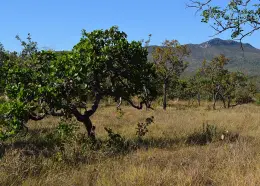
The vegetation and terrain of Serra Dourada offer one view of the Cerrado in Goiás. This regional landscape provides context for the workshop’s interest in land and grazing systems.

Seen from space

On 19 May 2025, Landsat 9 captured Serra de Caldas and its surrounding landscape. The image reveals another scale of observation, connecting this regional view with the work of remote sensing.

Three places, not one

Serra Dourada, the aerial photograph and Serra de Caldas are different locations. The rungs above change the instrument, not the place, and none of them shows the farm visited during the workshop.

Free time in Goiânia

Cafés, parks, culture and shopping. Check opening hours with each place before setting out.